Chronic Care Model Overview
| Site: | Caribbean Health E-Learning Portal |
| Course: | Chronic Care Model |
| Book: | Chronic Care Model Overview |
| Printed by: | Guest user |
| Date: | Sunday, 20 September 2026, 9:24 PM |
1. Video: State of the Health Care System (4 minutes)
Begin this module with a brief video lecture that will introduce you to health care systems. Downloads: Transcript2. Video: Non-Communicable Diseases (NCDs) (10 minutes)
Chronic diseases are by far the leading cause of death in the world, representing over 60% of all annual deaths. Of the 57 million deaths that occurred globally in 2008, 36 million were due to chronic diseases comprising mainly cardiovascular diseases, diabetes, chronic lung diseases and cancers (Alwan et al., 2010). This next lecture highlights the growing burden of non-communicable diseases (e.g., diabetes, cardiovascular diseases, hypertension, and cancers), prevalence, and risk factors in Jamaica. Downloads: Transcript This lecture referenced the PAHO publication The Case for Investment in Prevention and Control of Noncommunicable Diseases in Jamaica: Evaluating the return on investment of selected tobacco, alcohol, diabetes, and cardiovascular disease interventions (which you can download and read).Source: Alwan A, Maclean DR, Riley LM, d'Espaignet ET, Mathers CD, Stevens GA, Bettcher D. Monitoring and surveillance of chronic non-communicable diseases: progress and capacity in high-burden countries. Lancet. 2010 Nov 27;376(9755):1861-8. doi: 10.1016/S0140-6736(10)61853-3. Epub 2010 Nov 10. PMID: 21074258.
3. Video: Chronic Care Model (10 minutes)
The Chronic Care Model, developed by the MacColl Institute for Healthcare Innovation in the USA, offers a structured framework for the enhanced management of chronic conditions. In the past, shortcomings were often attributed to individual physicians who may not have always made the best decisions. It is crucial to shift the focus towards the healthcare system itself and the quality of care it delivers. The inception of the Chronic Care Model dates back to 1993 when there was a growing need to enhance the care provided to individuals with diabetes. Historically, healthcare literature has lacked organization in presenting what healthcare providers were doing and how they were achieving better results. To gain a comprehensive understanding, we must delve into the literature to scrutinize team compositions, their actions, patient interactions, visit scheduling, and more. Clinical trials extend beyond mere medication comparisons; they establish a systematic approach to regular care and follow-up, incorporating standardized assessments. Research is often geared towards specific conditions due to funding sources. However, there is a pressing need to establish a consistent care framework that applies universally, whether the patient is dealing with asthma, depression, multiple sclerosis, or other conditions. This standardized approach is beneficial both for healthcare providers' sanity and the patients, who should not be burdened with managing multiple case managers, numerous providers, and redundant medical records. A comprehensive literature review identified several recommended improvements, which were subsequently reviewed and revised by an advisory committee consisting of 40 members, 32 of whom were actively involved in the process. This revision process also involved interviews with 72 nominated "best practices" and site visits to select healthcare facilities. The Chronic Care Model can be effectively applied to a wide range of chronic illnesses, healthcare settings, and various target populations, including but not limited to diabetes, depression, asthma, congestive heart failure, cardiovascular disease, arthritis, and geriatrics. The model has been adopted by the PAHO as the basis for the action plan for managing chronic conditions. It is used in many countries and by health care organizations around the world (e.g., healthcare organizations in the USA, the UK, Sweden and some developing countries). It has been shown to be useful in organizing strategies to improve patient outcomes and reduce costs for many chronic conditions The World Health Organization (WHO) has recommended the CCM for health care systems worldwide The approaches advocated by CCM change the environment in which doctors and patients make healthcare decisions and, through this, can have an impact on the nature and quality of the doctor–patient relationship and on health care more broadly. Let’s look at a brief example before we dive into the Chronic Care Model Overview lecture. When patients are more informed, involved, and empowered, they interact more effectively with healthcare providers and strive to take actions that will promote healthier outcomes (Bodenheime, Lorig, Holman, & Grumbach, 2002). So productive interactions involve both a prepared practice team and informed activated patients.
We can define a prepared practice team as a healthcare team (at the time of the visit) have the patient information, decision support, people, equipment, and time required to deliver evidence-based clinical management and self-management support When we say “informed, activated” patient, we need to help our patients become more involved in their care. We need to allow for cultural and age cohort variations and personal preference in the amount of involvement. Our interactions need to foster the patient’s sense of control and responsibility. We want the patient to understans the disease process and realize his or her role as the daily self-manager. Family and caregivers are engaged in the patient’s self-management. The provider is viewed as a guide on the side, not the sage on the stage! So, how would I recognize a productive interaction? This is how you would know good chronic illness care if you saw it.
- Assessment of self-management skills and confidence as well as clinical status;
- Tailoring of clinical management by stepped protocol;
- Collaborative goal-setting and problem-solving resulting in a shared care plan; and
- Active, sustained follow-up.
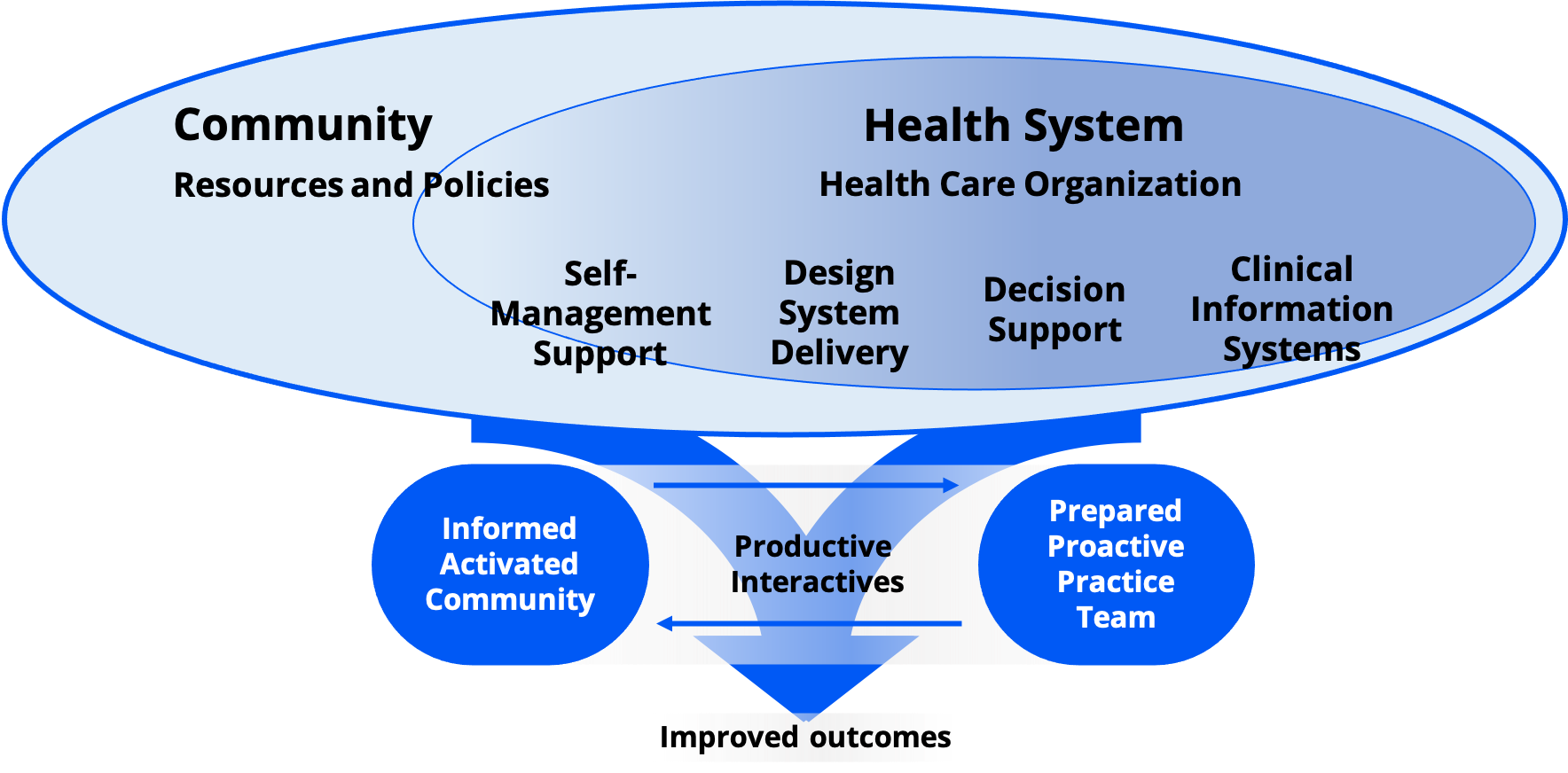
This next video lecture will review the history of the Chronic Care Model, general principles, and share examples. Downloads: Transcript
Sources:
- Wagner EH. Chronic disease management: what will it take to improve care for chronic illness? Eff Clin Pract. 1998;1:2-4.
- Taplin S, Galvin MS, Payne T, Coole D, Wagner E. Putting Population-Based Care Into Practice: Real Option or Rhetoric? J Am Board Fam Pract. 1998;11(2):116-26.
- Anderson R. Patient empowerment and the traditional medical model: A case of irreconcilable differences? Diabetes Care. 1995; March. 18(3): 412-415.
- Bodenheimer T, Lorig K, Holman H, Grumbach K. Patient self-management of chronic disease in primary care. JAMA. 2002; November. 288(19):2469-75.
4. Video: The Expanded Chronic Care Model (2 minutes)
Continuing our conversation about the Chronic Care Model, we will now review the Expanded Chronic Care Model, which has been used in Canada and elsewhere. The Expanded Chronic Care Model recognizes the roles of healthy public policy, healthy living environments, healthy communities, reoriented health services delivery, improved decision support for optimum care, enhanced self-care skills of people, partnerships of stakeholders, and information systems that can assess the impact of interventions. Downloads: Transcript5. Reading: Module Summary
Thank you for completing the first of 4 modules in this course on “Implementing the Chronic Care Model for the Management of Noncommunicable diseases (NCDs) in the Primary Care Setting.” The Chronic Care Model (CCM) is not a quick fix or a magic bullet; it is a multi-dimensional solution to a complex problem. The CCM is an important strategic framework for innovation in the healthcare community. The model identifies the essential elements of a health care system that encourage high-quality care. These elements are the community, the health system, self-management support, delivery system design, decision support and clinical information systems. The model acknowledges the central role of the patient in their care that involves a responsibility for their own health. It involves an integrated approach with development of care plans and support. It is perceived as a framework for change. The Expanded CCM introduces health promotion to individuals and communities for prevention and management of chronic disease. The Expanded CCM supports the intrinsic role that the social determinants of health play in influencing individual, community and population health.6. Resources
Download and save the folowing resources for future reference:- The Chronic Care Model.
- The Chronic Care Model. Improving Chronic Illness Care.
- Organizing care for patients with chronic illness.
- Counterpoint: chronic illness and primary care.
- The expanded Chronic Care Model: an integration of concepts and strategies from population health promotion and the Chronic Care Model.
7. Activities: Module 1
Thank you for completing the module. Next, please complete the module 1 quiz. We have also included an optional discussion forum, if you would like to participate.